
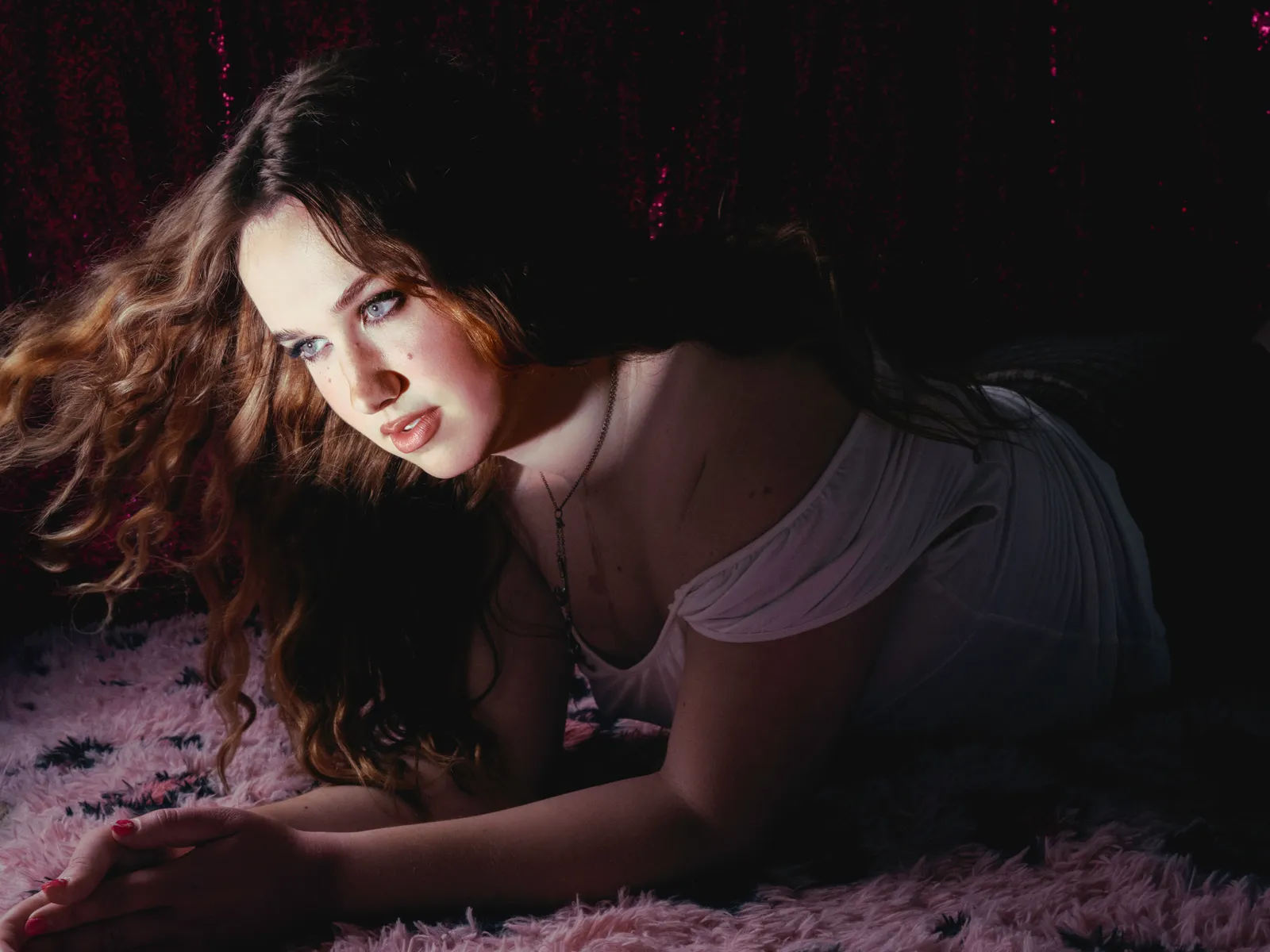
From the very beginning, self-professed “Stage Girl” Eli knew she wanted to make an album about a starry-eyed girl journeying through a singing competition. “Growing up, a lot of my dreams and ambitions were intertwined with that era of shows [like American Idol], and it shaped how I saw being a musician,” Eli tells Teen Vogue over Zoom from her chaotic bedroom in Los Angeles, a silver iPod earbuds necklace dangling from around her neck like a talisman, disappearing every so often beneath a thick mane of glossy auburn curls.
A childhood fascination with reality TV talent competitions followed the breakout pop artist into her early career years, when she found herself around other singers who had been on similar shows. The experience eventually culminated with her glitzy debut pop album, Stage Girl, which dropped in October 2025. “I auditioned for one of those shows five times growing up but never got on, so there was this sense of frustration watching all these amazing singers I was inspired by, thinking, ‘Was I not enough to be part of this?’ I carried all the times I heard ‘no’ into the project.”
If your TikTok For You Page’s algorithm has veered into the pop music space any time over the past year, chances are you’ve already heard of Eli. Or, rather, heard Eli. The 25-year-old began to blow up on TikTok in late 2024 under the handle @journalofadoll, her palpable star power bursting through scrolling cellphone screens like a deliciously deluded X Factor contestant ready for her close-up. Sharing her raw demos on the app, the musician’s transcendental sound—nostalgic, early 2000s bubblegum mixed with Imogen Heap-esque ethereal vocals, relatable lyrics, and modern pop je ne sais quoi—drew in listeners like moths to the proverbial flame. They frantically begged for more in Eli’s comments, and she faithfully obliged.
Last spring, she dropped her breakout single “Marianne,” a complex sapphic heartbreak track about the breakdown of a real-life relationship. The song propelled Eli’s IYKYK scope of fame to more tangible viral heights. Then came the almost prophetically titled “Girl of Your Dreams.” Released in June 2025 and inspired by the breezy millennial R&B-pop of the likes of JoJo, Stacie Orrico, and Vitamin C, the upbeat track sounded like something you’d hear while shopping at Limited Too or Delia*s with your mom in the early 2000s. The song, a sassy kiss-off to a boy who took her for granted, went wildly viral, racking up 2.4 million streams on Spotify to date, while celebrities including Meghan Trainor, Jazmin Bean, and Lizzy McAlpine used it to soundtrack TikTok videos.
Long before she went viral, however, Eli was just another dreamsick tween growing up in a small town in Massachusetts, where she attended public school and often found herself feeling like an outsider, disconnected from the typical suburban trajectory of her peers and neighbors. She wasn’t exactly a theater kid, but she certainly was theatrical, drawn to the dazzling siren song of the stage. The outside world was a sort of creative prison for her back then, all typical social expectations and bourgeois monotony, but in the whimsical sanctuary of her bedroom, she escaped into the glittery haze of pop music, losing herself in the CDs of Katy Perry, Ariana Grande, Mariah Carey, and Britney Spears, as well as shows like Hannah Montana and American Idol. She longed to express herself as freely as the pop divas who made her feel a fleeting sense of belonging, and so she put on impromptu performances for her family members every chance she got.
In her early teenage years, the singer, songwriter, and producer found viral fame under a different name singing covers of her favorite songs on the now-defunct video app Vine. She eventually started writing her own songs and pitching them to other artists, and briefly studied Recorded Music at New York University before dropping out in 2023. Not long after, she moved across the country to Los Angeles with nothing but a vintage fedora on her head, stars in her eyes, and a dream in her heart. Her grown-up bedroom became her new studio, and she soon found herself signed to Mark Ronson’s Zelig Records, in partnership with RCA. Like something out of a Disney Channel Original Movie starring Hilary Duff, her dreams were slowly but surely coming true.
In October 2025, Eli dropped her aptly titled, debut, meta-goes-concept album, Stage Girl. Functioning as both a delightfully camp concept album and deeply personal pop diary, the record—as well as the world Eli has built around it via an almost grassroots social media marketing campaign, complete with vlogs and one-woman shows—chronicles the fictional journey of a bedroom pop star wannabe-turned-singing competition hopeful à la American Idol, Making the Band, or Popstars.
On Stage Girl, Eli sings about love, gender, spectacle, sexuality, dreams, trauma, and ambition over a catchy soundscape of shimmering R&B and brisk, sunny pop. The production is magnetic, both fresh and nostalgic all at once, but it’s Eli’s voice that truly takes center stage. The vocal powerhouse flutters effortlessly between delicate falsetto and powerful belting, injecting each candid lyric with a powerful emotionality, even when she’s at her most cheeky lyrically.
Funky album opener “Stars (Lullabye),” which wouldn’t sound out of place on Spears’ debut record …Baby One More Time, sees the singer patiently lament the low emotional intelligence of an ex. On the bouncy R&B love song “Like a Girl,” the singer lets her hair down even looser, chronicling a relationship that makes her feel accepted and self-actualized. The record closes with queer synth-pop anthem “Somebody I’m Not,” which captures Eli’s anxieties regarding her identity and living life authentically. “I don’t wanna die in the body of somebody I’m not,” she sings, almost pleading against a swirling disco backdrop.
While the production is glossy and fine-tuned, the album also undulates with a raw, DIY energy, as if it were pieced together like the colorful, scrappy dream board on the wall of a tween’s bedroom, all glamorous magazine cut-outs and cheesy, earnest affirmations. Much of the project is rooted in the idea that the in-between is meant to be celebrated just as much as the outcome. In that vein, Stage Girl captures the exhilarating, butterflies-in-your-stomach junction between hope and nervousness one might experience in the moments leading to a big audition. Whether for a musical, job interview, or talent competition, Eli says there’s a special “feeling of ambition and imperfection” that goes hand in hand with putting yourself out there. “The version of you before the stage, before you got your first guitar, before you opened that stadium tour—can that be celebrated as fabulously as when you’re shredding down, playing with Slash on stage?” she muses aloud, but it seems she already has her answer.
“Glitter,” Eli’s latest single, encapsulates her brand of effervescent, playful vulnerability in just over three minutes. The coming-of-age anthem was recorded after Eli had already finalized the track list and submitted her finished album. The sparkly track was crafted in the studio with “two amazing pop heads,” Mike Wise and Sean Kennedy, who also worked on “Girl of Your Dreams.” “We got together after not seeing each other all summer and realized we had only scratched the surface with the sound of [‘Girl of Your Dreams’] … To a lot of people it’s a throwback sound, but to me it sounds like authentic joy. I wondered if this new version of myself could take some of those [nostalgic] sounds that I still love into Pop Diva Land today,” Eli shares.
“Glitter” is about reclaiming, or perhaps reframing, a bittersweet feeling from Eli’s childhood; a time she felt she was “chasing after the glitter.” Though it’s not technically on the album, Eli still very much considers the song an important part of the Stage Girl listening experience. “It’s giving, ‘I went on the Stage Girl competition, made it to Hollywood Week as the wild card, but then got booted off by the annoying, transphobic judges.’ Like, the confetti fell, but not for me,” she describes, adding, “I didn’t make it onto the show, but I still took that energy with me and started making songs like Jordin Sparks. ‘Glitter’ is the encore, it’s what comes after the curtain closes.”
Across all the tracks on Stage Girl, Eli’s music could be distilled into a single, powerful message, one that resonates across generations and genres: Be yourself. It’s baked into her unabashed joy and optimism, into her determination to chase her dreams despite the odds, and into her puckish relationship with her fans. It’s her modus operandi, her mission statement, her directive to the masses. It’s also something that has crossed over into her image.
Though Eli is squarely Gen Z, her aesthetic is steeped in a certain era of hammy millennial pop culture, particularly a lesser referenced stretch of the mid-2000s. In her promotional graphics, album, single covers, and social media videos, Eli presents a unique fusion of nostalgia: post-Y2K Disney Channel motifs mixed with the iconic silhouette iPod commercials from the 2000s and the bubbly, candy-colored Frutiger Metro aesthetic, complete with vector blooms, starbursts, and music notes. Her clothes reflect these somewhat niche visual elements, pulling from mismatched, mid-aughties, layered boho-pop teen fashion (think Ashley Tisdale on the red carpet) instead of the cyberfuturistic, Y2K outfits or Juicy Couture fabulicious styles often associated with the decade. There’s an air of referential, DIY kitsch to her visual elements that might come off tacky or cheap to the non-pop culture au courant, but ultimately feels refreshingly earnest, fun, and new.
For Eli, who is a trans woman, this over-the-top, girlhood-referencing aesthetic feels “more fresh and less like a throwback” since she wasn’t able to fully immerse herself in the world it came from when she first experienced it as a child. “I get this foggy feeling when I see those old Disney Channel commercials I used to watch on the TV in my house in Massachusetts. Back then, all those things I absorbed subconsciously were examples of shame and restriction; things I couldn’t go near. I’d go over to a friend’s house and she’d dress me up in a sequin top and feather boa, and then I’d get bullied by her brothers,” Eli reminisces. “So now there’s this super joyful feeling of, ‘F*ck yeah, I can wear a sequin top! I can wear pink! I can wear those mismatched, colorful, feminine outfits!’ It feels more special now that I have this artistic freedom of expression. It’s less like conscious nostalgia and more like a dream state—something that feels familiar but also feels so exciting, like the past meeting the present.”
This irreverence has colored Eli’s sparkling, tongue-in-cheek online persona, whether she’s getting run over by a badly CGIed bus Regina George-style in a TikTok video, performing in a Spirit Halloween parking lot, or starting a fake feud with Zara Larsson. Both pop star and pop stan, her ability to deftly flit between the best of both worlds, Miley Stewart-style, has resulted in a congenial, charming mass appeal. “I do think there is a balancing act, but playfulness feels like an integral part of myself. Sometimes it’s a coping mechanism, like I’m hamming up the jokes because I’m nervous, but also, joy and silliness are very important in my life,” Eli muses. “I try to keep everything in check. Gotta keep an eye out for Selener.”
These days, Eli isn’t just an unapologetic pop stan—she’s got some majorly famous fans of her own. Demi Lovato and Adéla made appearances at her sold-out One Woman Show in LA, which also saw Olivia Rodrigo in attendance. SZA, Tori Kelly, and Doechii are just a small handful of the many artists who have hyped her up online. Addison Rae’s been in her DMs, and she’s been out for coffee with Muna’s Katie Gavin. “It feels magical and surreal. It also reminds me that there isn’t a threshold, because a lot of these people I idolize or have been inspired by or resonate with, they’re also just fucking weirdos who make music and geek out at the same things as me,” Eli shares. “An icon like Sam Smith is also just a kid who grew up on the outside in the rural U.K., who had a knack and a need to sing and write and create, babe.”But it goes beyond personal validation. “It’s a reminder that [the music industry] can be nourished and uplifted beyond the massive photo opps like the MTV Video Music Awards. We’re all in this together in the pop community, and it doesn’t have to be, like, the 2001 competition between the pop divas, because I don’t think that helps anyone. There’s so much opportunity for community… and that’s why I’m getting a coffee with Beyoncé tomorrow,” Eli adds, laughing. “Being delusional is also really fabulous. It’s all about radical optimism.”
Still, that sense of community is also more important than ever. In an increasingly hostile world where people appear to be constantly on edge, waiting for their next negative interaction or online hate comment, Eli maintains an air of levity in the face of uncertainty, including the rising transphobia in the U.S. and legislative attacks against her very existence. Eli laughs and smiles a lot, both during our interview and as she interacts online in general. She’s bright and full of joy, radiating with kindness and a sort of self-aware empathy as she makes self-deprecating jokes, dishes out compliments, and sings the praises of those who either influence or support her. This self-assured grace is something she credits her mom with instilling in her, and it’s also something that has allowed her to reframe feeling “othered” in society.
“Being a trans woman, and sometimes feeling like I’m on the outside of something, it gives me the opportunity to be so radically myself, unafraid to show up,” Eli says. “You can feel alone, isolated, misunderstood, but it’s also an opportunity to hold onto community. Sometimes I’ll have a day where I’m fucking terrified to exist, but then I’ll remind myself: I had a good-ass coffee this morning, my new song is out, there are people that love me all around me, and I’m gonna be OK.”
Eli’s circle is growing, too. One of her latest co-signs is the aforementioned Larsson, the Swedish pop princess currently going viral for her Lisa Frank-hued dance-pop anthem “Midnight Sun,” as well as her remix feature on PinkPantheress’ “Stateside.” Soon, she and Eli will maximize their joint slay on a remix of their own for “Crush,” Larsson’s most recent single. “She’s a busy diva, traveling the world, but we’re having a little kiki soon. It feels so inspiring that she’s reaching down to a girl like me,” Eli gushes. “She really cares about artists who are part of the culture, and she’s a real, sweet, funny human being, as well as a fucking pop icon.”
Meanwhile, Eli’s own icon status is expanding. In March, she’ll embark on her Eli Is the Next Stage Girl Tour, marking her first official North American trek to promote the album. Inspired by artists such as Chappell Roan and Ethel Cain, Eli, who was recently nominated for Outstanding Breakthrough Music Artist at the GLAAD Media Awards, is most excited to create a celebratory, welcome space for fans to express their most joyful versions of themselves.
“I want to experience this moment for the first time together with that other queer person in, like, middle America. As a person in this community, that’s what this album was made for and about,” she says. “I want to create an accessible and fun environment where whoever is coming has an opportunity to be their most extravagant, embellished self, whether it’s a queen in a fucking ball down or a masc diva in a white t-shit and blue jeans. We are all stage girls, and this is your invitation.”
Obvious talent aside, Eli believes much of her success thus far has been a result of her strong-held belief in herself, something she credits with watching motivational speaker Abraham Hicks’ YouTube videos on the Law of Attraction and manifestation. “There was something that she said that really stuck with me, which is, ‘A belief is just a thought that you repeat.’ I thought, ‘Well, if I want to believe this about myself, that I’m the next stage girl, I need to keep repeating it.’ Not actually saying it out loud, but letting it inform everything I do, and how I think,” she explains.
As for 2026, Eli would love to perform at a festival, on a late-night TV show, or daytime talk show. “I know Kelly Clarkson and I would get down,” she says, giggling. She’d also like to develop more patience and discipline for herself; a routine or ritual to ground herself because “as Stage Girl and music opportunities have picked up, it’s been hard to find the calm within the storm. ‘No sleep, bus, club, another club…’ I want to value that more this year.”